
AI Pre-Screening for Social Good
Designed to enhance safety across current AI companion products, Grounded AI functions as a plug-and-play, white-label extension. Its platform-agnostic visual identity ensures effortless integration across diverse ecosystems, structuring the initial pre-screening phase to establish clear AI boundaries, outline capabilities, and surface support resources from day one.
-
Brand Strategy: Platform-Agnostic UI engineered to inherit host system variables (e.g., Replika, Character.AI, Nomi.AI) for zero-friction integration.
-
Color System: Dynamic & White-Label (Themed via host application tokens)
Proposed Legislative Safety Framework
AI Ethics, Youth Protection, White-Label UI System
7 months
Lead UX Designer & Researcher
Discovery & Foundations
User Research
To inform the framework, I conducted secondary research across AI companionship dynamics, emotional dependency risks, consent practices, privacy requirements, and emerging AI regulations.
-
Initial assumption: Users would resist onboarding friction and safety guardrails.
-
Key insight: Users actively welcomed transparency, explicit agency, and clearly defined relationship boundaries prior to interaction.
Methods: Literature Review · Regulatory Analysis · Competitor Audit · User Feedback Synthesis
Pain Points
Persona: Alex Ramirez
Problem statement: Alex is a tech-savvy Millennial professional who needs transparent emotional boundaries when interacting with AI companions because he wants support without sacrificing autonomy or become emotionally dependent.

User Journey Map
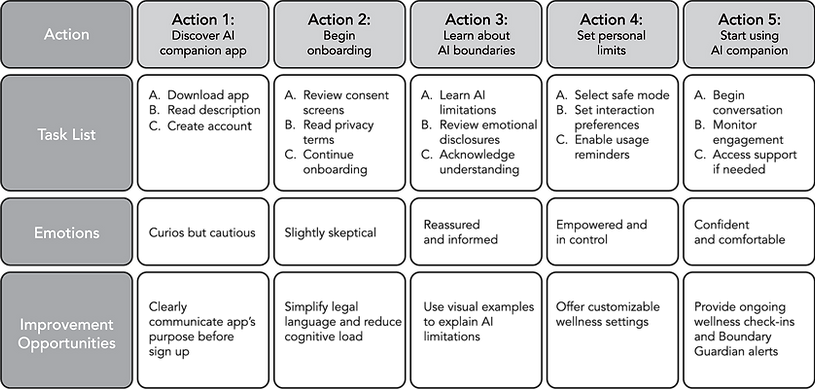
User goal: Safely explore AI companionship while maintaining emotional well-being and control.
Journey stages:
1. Discover AI companion app
2. Begin onboarding
3. Learn AI limitations
4. Choose interaction preferences
5. Engage with AI companion
6. Monitor emotional engagement
7. Seek support if needed
Opportunity: Introduce trust-building safeguards early in the user journey.
User Flow
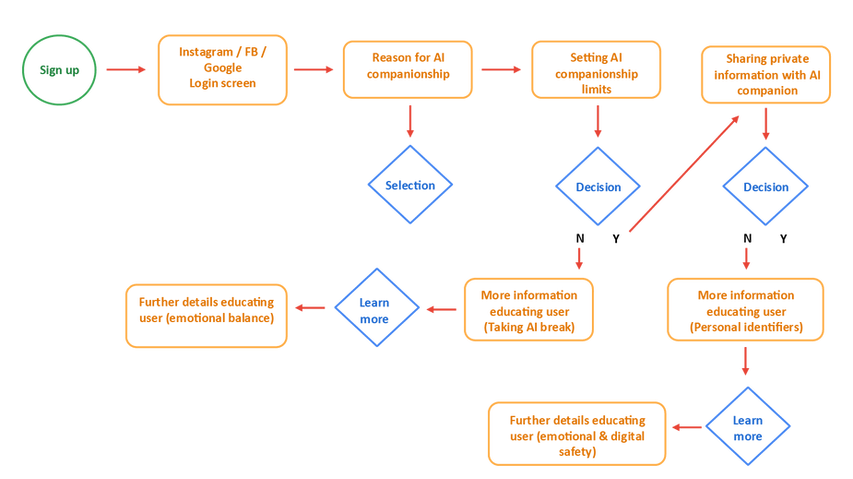
Goal statement: The AI companion pre-screening will let users safely interact with AI chatbots which will affect users who have to rely on digital companions for validation, research, information and other needs by informing users about the limitations of ai chatbots saving them from emotional dependency and reliance on synthetic connections. We will measure effectiveness by tracking successful pre-screening completion without drop-off.
Concept & Structure
Paper Wireframes
Iterating layouts early on paper ensured that key elements in the digital wireframes directly addressed user pain points. Key focus areas include embedded user education, a simple consent process, customizable emotional boundary selection, and high visibility for crisis support resources.

Building on findings from user research, I translated early concepts into digital wireframes to establish a clear structural foundation.
I incorporated feedback from UX design peers to refine the onboarding flow, ensuring a seamless and effortless setup experience for users.

Digital Wireframes
Goal: Validate whether users would complete a safety-focused onboarding process.

User Benefit: Provides control and prevents automatic emotional escalation.
Testing & Refinement
Usability Findings
Moderated and Unmoderated Usability Testing: 7 participants consisting of a short introduction with follow-up questions.
Round 1 Findings
-
Users appreciated transparency
-
Users wanted softer language
-
Users preferred guidance instead of restrictions
Round 2 Findings
-
Users requested session limit reminders
-
Users wanted clearer crisis pathways
-
Users completed onboarding without drop-off
Color & Accessibility Considerations
Agnostic, Multi-Brand Palette
Instead of a single fixed brand identity, the interface is engineered as a dynamic, white-label extension using tokenized color variables. UI components, such as buttons, cards, modal overlays, and active states, inherit the host application's primary, secondary, and neutral properties.
This ensures that whether embedded in Replika, Kindroid or Character.AI, the feature feels like a native, integral part of the core product experience rather than a standalone add-on.
-
Dynamic Theming: UI elements dynamically pull from the host app’s background, surface, text, and primary accent variables.
-
Seamless Integration: Eliminating custom brand colors prevents immersion breaks, maintaining seamless visual continuity across both dark and light modes.
-
Accessibility Compliance: Token mapping automatically enforces WCAG AA contrast ratios across varying host color schemes.
High-Fidelity Mock-ups
Engineered with tokenized color variables to dynamically adopt the host app's brand identity.
Entry: Primary Orientation

Replika

(character.ai)
Task Flow: Happy Path


Replika


(character.ai)
Form Submission: Qualitative Intent Gathering & Customization

Replika

(character.ai)
Feedback States: Conditional Branching and Risk Mitigation

Expectation Management

Expectation Management

Safety Intervention

Safety Intervention
Key Interaction: User Demographics Onboarding Input

Replika

(character.ai)
Reflection & Looking Ahead
Project Takeaways
Impact
User testing achieved a 100% onboarding completion rate, demonstrating that safety features can coexist with engagement.
What I learned
Responsible AI design requires balancing business goals, emotional wellbeing and regulatory expectations.
Transparency became a competitive advantage instead of a barrier.
Next Steps
Conduct testing with larger user groups.
Develop adaptive emotional wellness interventions.
Pilot GroundedAI with AI companion platforms and measure trust, retention and compliance outcomes.